
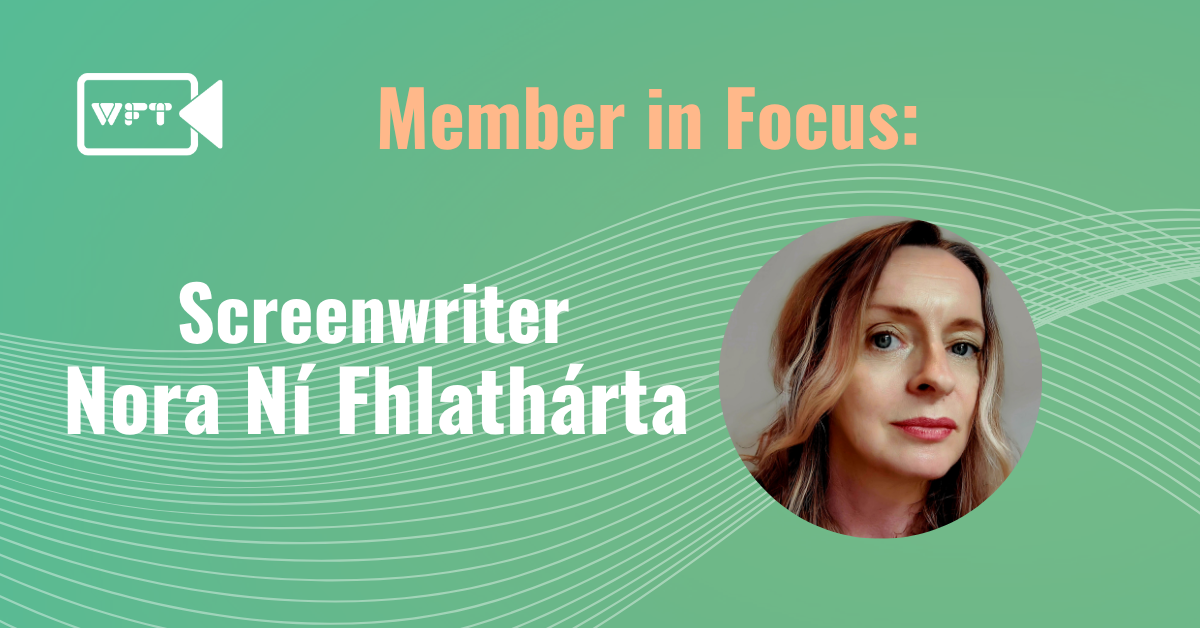
We are proud to celebrate the work and journeys of our members across the screen industries, and this month, our Member in Focus is screenwriter, lecturer and multidisciplinary artist Nora Ní Fhlathárta, whose work brings together folklore, mythology and dark humour with a striking visual sensibility.
Before turning her focus to screenwriting, Nora spent over a decade working across multiple departments in the film and television industry, alongside a long career in education. As Programme Leader of the Creative Broadcast & Film Production programme at the Technological University of the Shannon, she has taught cinematography, VFX and creative design, while nurturing the next generation of filmmakers.
In recent years, Nora has embarked on a powerful new chapter in her creative life. Following a life-changing health-challenge in 2022, writing became both a creative outlet and a vital part of her recovery, opening the door to a new path in storytelling. Since then, her work has continued to gain recognition, supported by development initiatives including Stowe Story Labs and Screen Ireland.
Her gothic comedy-horror short script The Bride Andromeda was recently shortlisted at the Horror Hound Film Festival in Cincinnati, where Nora attended to present the project. Drawing on myth, transformation and the unsettling power of beauty culture, the story reimagines the figures of Medusa and Andromeda through a sharp, contemporary lens.
Alongside this project, Nora’s feature screenplay The Disruptor, a punk Irish road-movie dark comedy, was selected as finalist in the Berlin International Screenwriting Festival (Spring 2026).
She recently attended the Galway Film Fleadh and Catalyst International Film Festival Screenwriting Lab, where she has been developing new work and seeking collaborators.
We spoke with Nora about her creative journey, the inspiration behind The Bride Andromeda and the role storytelling has played in reshaping her life and work.
- Your career spans teaching, industry work and now screenwriting. Could you tell us a little about your creative background and what first drew you toward the film world?
I’ve always been captivated by stories; they made more sense to me than the world around me. I especially loved anything with magical realism, the intersection of mythical beings with our everyday lives. Irish mythology is full of fascinating characters. Ná Sídhe, the Red Branch Knights, Queen Maeve, Selkies, Banshees and all made of piseógs.
I still recall the night my elder sister Mary came home from her job at O’Connor’s electricals in Shop St. Galway, it was also one of the first video rental outlets in the town. She brought home a Betamax player and a collection of films, mostly Disney movies since we were so young. The ability to stop, rewind, and replay was fascinating to me, much like revisiting a favourite passage in a book or comic.
As a teenager, my passion for stories deepened through theatre. I was driven by the desire to create those worlds myself and explore complex themes through characters that felt real. I joined the Galway Youth Theatre, read countless plays, and primarily worked on the production side of things. I loved the tactile, immediate nature of theatre.
During my undergraduate studies in Arts at UCG, in English and History, my final thesis was on the writing of Roddy Doyle and the representation of the family unit in the Barrytown trilogy and the TV series The Family. Since it was so new, there was hardly any academic writing about it that I could reference in my thesis, so I took the audacious step of writing directly to him with my questions, not really expecting a response. To my delight, Roddy, being the consummate teacher and genuinely lovely person that he is, replied and even gave me notes on my questions and the direction I was taking, it was brilliant.
What keeps me motivated now is knowing that every story I write has the potential to resonate with someone, pull at an emotion, or provoke an impression like literature, film and theatre has to me over the years, I identified with the characters in these stories, I understood them. I want to make people feel seen and understood in the same way in my stories if I can.
- Your script The Bride Andromeda was shortlisted at the Horror Hound Film Festival in Cincinnati. How was that experience, and what did you take away from attending the festival and connecting with other filmmakers there?
The Bride Andromeda has certainly made a striking debut by being nominated for Best Plot at the Horror Hound Film Festival in Cincinnati, Ohio. The experience was truly remarkable. Attending the festival allowed me to connect with a community of filmmakers passionate about storytelling through exciting visuals, all viewed through a horror prism. The entire convention and film festival were awe-inspiring.
I travelled there with my son, Cathal Mann, a budding filmmaker himself and currently studying for the Leaving Cert, and with Sharon Costelloe Desmond, a long-time friend from art college and the production designer of The Bride Andromeda. It’s funny; the last time the three of us worked on a creative project together was back in 2007/8 when I was producing the drama documentary Ar thoir ar Granuaile for TG4. Sharon designed the look and starred as Granuaile, while Cathal played her baby son, Thiobold. He was only around four months old at the time, and I was still breastfeeding him between shooting, producing, operating the second camera, and scripting the piece.
Those are the things a working mother does! So going to the Horror Hound Festival together nearly 20 years later was wonderful.
Witnessing the collaborative spirit of the festival affirmed my belief that community is essential in the artistic process. It opened up a network of support that is invaluable to any writer. The connections I made there empowered me to continue pursuing my passion with confidence.
After that, taking The Bride Andromeda to the screenwriting lab at Catalyst was perfect timing, I was coming off the back of the Horror Hound experience, and my brain was in overdrive with possibilities. The two script mentors, Lena Byrne and Ciarán Hayden, were brilliant to work with, giving me permission to explore alternative identities within the narrative, which I was afraid might be pushing things too far. On the contrary, Lena encouraged me: “You don’t need permission, you’re the writer. Go for it! You have already given yourself a good note; now apply it.” I have, and I am in the middle of multiple passes in re-drafting.
Thankfully, I attended the Stowe Narrative Labs in Vermont (thanks to a bursary from Screen Ireland) so I could refine the new drafts ready for handover. This, to me, is the most exciting part; though it is scary, exhilarating, and anxiety-ridden all at once, I love it!
- In some of your writing, you have reflected on a very significant and life-changing period that led you to focus more deeply on storytelling. If you’re comfortable sharing, how did turning to writing during that time influence your voice as a writer and the kinds of stories you feel drawn to tell today?
I think it’s important for me to discuss my experiences openly for my own recovery, and if it encourages someone else to feel more comfortable speaking up, then I’ve done some good. When I first returned to work, I tried to cover up my disability. I jokingly sent a clear message to my colleagues in our group chat, expressing my excitement about returning and thanking them for all their support during my rehabilitation in Dunlaoire. I also made it very clear: “The first rule of Fight Club is, we do not talk about Fight Club!” I knew they would get the reference. I didn’t want to discuss my stroke recovery, nor did I want to be treated any differently or even acknowledge that I was still affected.
On September 25, I published an article on LinkedIn detailing how the brain injury had impacted me physically, emotionally, and psychologically. This was nearly three years after the stroke. It takes time to process everything, I guess.
At the time I faced challenges with memory and concentration and had to focus on pushing neuroplasticity to work around the damaged section. Recovery from brain injury (stroke) requires dedicated effort to reroute neural pathways, involving both physical rehabilitation and cognitive exercises to regain lost skills. Writing became essential in this process, and I took it as seriously as regaining the ability to walk or use my left hand again. Since my left side was out of action, I’m a citóg (left handed) I couldn’t hold a pen but I could still type, albeit badly. I started pounding the keyboard and writing stories. Capturing memories and snapshots of my life. The Disruptor is one such story from my teenage years, reflecting my experience of getting knocked up and locked up in a mother-and-baby home at 18, the year was 1992. I think our generation was the last of them. Bessborough in Cork, the one I went to, was “repurposed” by the late-nineties. It’s a deeply personal project, cathartic in a way. Screenwriting has helped me process and share that journey so many years later. Throughout my life, I’ve adopted the Scarlet O’Hara approach: “I can’t think about that right now. If I do, I’ll go crazy. I’ll think about that tomorrow.” (Gone with the Wind) Compartmentalising her pain, Scarlett would make a therapist’s dream!
Since my stroke, I’ve been in therapy. I remember my first one-on-one session vividly. I spilled out everything in one breath, two hours later, the counsellor sat back, stunned. When he finally caught his breath, he said, “Nora…you have lived five lives there!” I’ve learned to slow it down, break it apart, and unlock each chamber of my experiences. There’s no rush, a lot to navigate. As Scarlett observes, “After all, tomorrow is another day!”
- Thank you, Nora, for sharing such a personal part of your journey with us. It’s a powerful reminder of the ways storytelling can help us make sense of our experiences, while also creating space for others to feel seen. Your work blends striking visual ideas with storytelling. Given your background in cinematography and creative design, how does the visual world of a story influence your writing process?
My writing process usually starts with a spark of an idea or a theme I’m really passionate about. For instance, with my upcoming project The Bride Andromeda, the entire experience of preparing for my daughter’s wedding in 2025 inspired me. It was a whirlwind of excitement, combined with the near-perfect image of engagement pictures stuck in my mind, the engagement nails, the perfect ring, the romantic embrace, the beautiful flowers, and the moment when my daughter exclaimed, “Mum, for God’s sake, shave your armpits!” It felt like a scene straight out of the Barbie movie: “The most casual, fun, non-choreographed get-together ever!” This made me wonder what someone might go through to capture that ideal image of themselves.
I often think about the ending first; having a clear idea of where I want my story to go helps shape the entire narrative. From there, I create a detailed outline to map out the structure, which is something I truly value. Once I dive into the first draft, I try not to overthink it, I just let the words flow and embrace the spontaneous nature of a wandering mind. It’s often a stream of consciousness, filled with a lot of necessary silt just to find a tiny bit of gold dust. As long as I have my story beats down, it gives me permission to explore.
For The Bride Andromeda aesthetic, the sumptuousness of Interview with the Vampire is particularly influential. The humour in What We Do in the Shadows is very similar to that of It’s Always Sunny in Philadelphia, showcasing a group of narcissists bouncing off each other without a care in the world about their impact on the poor plebs around them. The vampire world, like the zombie universe, is a natural playing field for social commentary. The Bride Andromeda explores body image and metamorphosis, as well as the social media that drives it.
In art college, my graduate show was a series of three installations rich in texture and lighting. I was heavily involved in the Youth Theatre in Galway, so lighting and set design have always had a big influence on me. When going through the script, I wanted to create a project that had beautiful jewels for all the departments to get excited about from sound, art, and lighting to camera and costume.
The script for The Disruptor is full-on; writing it made me dig deep into my past, into compartments I had locked away long ago. I remember at the Stowe Writers Retreat in Renville, the writers there recommended always having a “fun” writing project to turn to when you get bogged down. The Bride Andromeda started off as that kind of project, but then it grew into something bigger, so Optimum became my little go-to on the side. Then that turned into something else! This morning, instead of answering these questions, I ventured off on another side road with a short piece called Water Bottles, I have a mind prone to wandering.
- You describe The Bride Andromeda as a gothic comedy-horror inspired by films like Interview with the Vampire and What We Do in the Shadows. Can you tell us more about character-building?
Creating characters is one of my favourite parts of writing!
I often pull inspiration from people I know or observations I make in everyday life. It’s amazing how much we can learn from those around us. I also love incorporating bits of dialogue I’ve overheard and quotes that resonate with me, as they add authenticity to my characters’ voices.
Music plays a significant role in my character development as well. After my stroke, which affected my spatial awareness and made me prone to sensory overload and anxiety driven panic attacks especially in public places, I became accustomed to wearing large noise-cancelling headphones, hats, and gloves to manage my environment. Music became a vital part of my recovery.
I usually start my day around 5 a.m. by watching a few choice music videos while making my first cup of coffee. Associating songs with each character helps me get into their mindset, I’ll pick their “calm song,” “angry song,” and so on. This musical connection enriches my writing process, allowing me to embody my characters more deeply as I write their stories. It adds a layer of emotion that I find incredibly helpful in bringing them to life on the page.
Music videos are perfect creative short films; some are abstract, some are inspired by the lyrics, and others offer an interpretation of the story within the song. All of them are interesting to me! They provide a brilliant kickstart to the morning, particularly those with strong direction and actors. Fontaines D.C. “A Hero’s Death” starring Aidan Gillan is pure joy. I recently had the pleasure of watching him perform the character “Harky” in the film Trad, directed by Lance Daly. I think he would make a fantastic Hermes for The Bride Andromeda, he’d have to dye his hair blonde of course, but I believe it would suit him 🙂 A girl can always dream!
- Comedy can often reveal difficult or complex truths in surprising ways. What role does humour play in your storytelling, particularly in genres like horror?
Humour in life is a form of survival. Looking back at my life, it’s clear that I shouldn’t even be here; my story could easily read like the worst kind of dreary tragedy. Yet, for me, the essential truth is that human beings can face horrific atrocities but they also possess the remarkable ability to heal, it takes time and support. Humour plays a significant role in that process, physically, psychologically, and spiritually. It offers an outlet that releases tension just like a good cry; you can either laugh or cry, and I choose laughter or a dance anytime.
When I tell people about my script The Disruptor, based on my experience of being locked up in a mother and baby home, their expressions shift to empathy, as if they expect to hear a tragic tale. It’s true that it was a sad time in Ireland, and while my story might seem pretty bleak on paper, my script is a punk dark comedy road movie with a soundtrack that kicks ass. It’s a joyous celebration of revolution, a narrative from the early nineties when a teenage girl stood up for herself and said no! I kept my baby, and in many ways, we grew up together. She is soon to become a mum herself, and I’m about to step into the role of grandmother, which is why I focus on the absurdity of the whole mother-and-baby system. Can you imagine one of the Derry Girls being placed in a mother and baby home? That’s the essence of The Disruptor, a true story that captures the spirit of a teenage girl who out of pure necessity morphs into a protective lioness protecting her cub. I think the women who came of age in the ‘80s and ‘90s were revolutionaries. Now, in our 50s, we’re still kicking ass.
We are born, I think, to be curious, to be kind, to celebrate, and to laugh at the absurdity of the human condition. By incorporating humour into my storytelling through horror and the use of music, I hope to uncover deeper complex truths and the duality of human identity. I love the final scene in Derry Girls season one, it’s a powerful, poignant moment that juxtaposes the innocence of the teenage characters with the harsh reality of “The Troubles” in Northern Ireland. It’s that blend of comedy and tragedy that enriches the narrative and allows for deeper emotional connections straight to the audience – we relax when we laugh, more open to feel. To gain a deeper understanding, to connect.
- You’ve spoken about how important development programs such as Stowe Story Labs and Screen Ireland initiatives have been in your journey. How have these experiences helped shape your work as a writer? Was there any particular moment during these programs where you felt a shift – something specific where you sensed a transformation happening in your writing or creative approach?
Definitely in writing The Disruptor, which is really close to my heart. It’s inspired by my own experiences as a teenage mother in a mother-and-baby home. The story follows Deirdre, a young girl who gives birth alone and navigates the emotional landscape of keeping her child despite societal and family pressures. Along the way, she’s paired with Lona, a woman with her own tumultuous past.
A particularly challenging moment occurred during the early stages of The Disruptor when I struggled to find the right balance between the emotional weight of my experiences and crafting a strong narrative structure. It was overwhelming to convey everything I wanted to say without losing the flow of the story. Honestly, it felt a bit too personal and still too close to the bone, even after 30 years.
Getting into the Galway Film Fleadh Stowe Writers Lab Facing In/Facing Out development workshop in July 2025 was definitely a turning point for me in having the confidence to view myself as a writer first and foremost. Back then, it was a short script based solely on one conversation. I just wanted to secure a producer to get the story out there, to hand it over. I remember speaking to David Pope about how difficult it was to secure a producer; nobody seemed interested in short form, they all wanted features or series. His answer was so simple and clear: “So write the feature!” I stood back, dumbfounded! I went home and started from there.
I reset my LinkedIn profile to “Screenwriter” and haven’t stopped since. I now have a feature script, two series, and a number of shorts, and the only thing stopping me is the number of hours in the day.
Up until January 11th 2022 – A Tuesday morning, I was a mother of four who worked full-time. I had a four-hour daily commute and was the program leader for both the Creative Broadcast and Film Production Undergraduate day programme and a flex learning Springboard Programme in Screen Production Department skills I had designed in collaboration with Screen Ireland. I was also pursuing a PhD and running a series of screening events and industry masterclasses throughout the academic year for the students. I had been driving myself forward on that scale for well over a decade. On that Tuesday morning my blood pressure spiked, a tiny capillary in my right cerebellum exploded. My brain forced my body to stop when I obviously was not listening to it. The resulting brain bleed rendered me instantly paralysed.
It’s been a long recovery in more ways than one. I still work at TUS but only part-time. I love working with the film students. Now, I have finally given myself permission to carve out some time in my life to write. I try to set some strict boundaries at home, it’s not easy. But that’s life, and it all goes into the writing mix. Writing labs are so important for allowing me to focus fully on my craft.
Attending the Stowe Writers Retreat in Renville in 2025 with so many talented writers was a life-changing experience for me. We lived together, and it felt like I was retelling the story of The Disruptor, my story, over and over again, like pitching it each time I sat down for breakfast, lunch, dinner, or just wandering around the grounds chatting. I learned to separate myself from the script and the characters from me. I fell in love with them for who they are. Deirdre and Lona became separate entities, and I wanted to give them the best chance to shine.
I gained that focus on characters from my mentors, Jessie Fisk, Ruth Meehan, and Karol Griffith. Script editors are worth their weight in rich dark chocolate or gold, whichever floats your boat. For me, it’s chocolate!
Working with trusted mentors proved invaluable. I know I would never have had the confidence to dive as deeply as I did without their support.
I also reached out to trusted filmmaking peers I worked with over the years for feedback, and their insights helped me refocus.
- As The Disruptor engages with such deeply personal themes, what feels most important to you about bringing it into the world?
I have waited over thirty years to open this Pandora’s box. I put it away and got on with living as a single mother in 90s Ireland, believe me, that was enough of a challenge.
Ireland is not unique in its long history of confusion over how to deal with wayward women who are incapable of conforming. We’ve seen women who have no interest in marriage and motherhood, or those who revel in the same freedoms as their male counterparts, only to discover that their physiological makeup is seen as ill-equipped to manage such lofty heights. For many women, religious life offered education, career, and travel opportunities. Sister Marlene in this story represents a multitude of female clergy I’ve encountered throughout my formative years, some good, some bad, just like any other walk of life.
In recent years, numerous reports, documentaries, films, and TV series have documented the atrocities carried out in mother-and-baby homes.
I had to learn to separate the story from the writer. Deirdre’s story isn’t verbatim; identities have been changed. I wanted the narrative to be one of redemption and hope, no matter how hopeless and small a person can feel. The only person who can make you feel small lives right inside your own mind. Controlling that inner voice is a superpower, but it takes time to develop. I wish I had more of it when I was younger.
I wanted to write this story in honour of the women who helped me and countless others, the unsung heroes. This story is my truth; I never saw myself as a victim, and I didn’t write Deirdre as one either. She’s a feisty character who is scared but ultimately finds the courage to shout NO! just as I did. I am forever grateful to my teenage self for that.
- You came to screenwriting after many years working across different areas of film and education. What advice would you give to creatives who feel drawn to storytelling but aren’t sure how to begin?
For emerging screenwriters, my main advice is to write fearlessly and keep writing. Get comfortable with being uncomfortable, and be honest in your storytelling. Let your experiences and observations guide your narrative; the more personal and authentic your work is, the more it will resonate with others. Embracing discomfort is a good sign you’re getting somewhere!
Be open to feedback, as it’s a crucial part of your growth process. Read widely, watch films critically, especially shorts, and stay curious about the world around you. Building connections with other writers can be incredibly beneficial too! Collaboration and conversations can spark new ideas.
Persistence is key, so keep writing for yourself, not for anyone or anything else. Every step you take can lead to something truly special. I learn from every lab I attend and every panel I listen to, always taking notes and writing up what I’ve learned afterward.
A few years ago, I heard Ailbhe Keoghan speak at a panel about her morning routine and what she did to get serious about writing. I’ve replicated that process, and it’s been a revelation for me. I started writing first thing every morning; 5:30 a.m. works best for me before I get the kids off to school. I also have my favourite spots, I adore libraries and trains. They’re perfect places to pop on my headphones and knuckle down. Plus, trains and libraries are great for daydreaming and people-watching, which inspires me!
The most important thing is to give yourself at least a two-hour uninterrupted block of dedicated writing time, no editing, no admin; just pure stream of consciousness. And if life gets overwhelming and things start to cave in on you, don’t be too hard on yourself. Just pick up where you left off the next day.
Gratitude is something I’ve really focused on since my stroke. Initially, I felt cursed by the universe, it was a very low and lonely period in my life. The way out, of course, is often the last thing you want to do when you’re in a dark place, be thankful to be alive. I had to start from scratch, like getting my left leg to start working again. It begins with a wiggle of the big toe and builds from there, just keep going!
My long-term goal as a screenwriter is to create powerful narratives that not only entertain but also inspire empathy and dialogue. I want to spotlight the complexities of human experience, especially for women and marginalised voices. My aim is to write honestly about what it means to be human, and if my work can resonate with someone and spark a broader perspective on the world and the beautiful characters who inhabit it, then I’ll be truly fulfilled.
- What are you hoping to develop next, and are there particular collaborators or creative partners you would love to connect with as your projects move forward?
Screenwriting is evolving rapidly, especially with the rise of streaming services that are hungry for fresh, diverse stories. Audiences are craving authenticity, stories that reflect their own experiences and challenge accepted norms. I see myself fitting into that future by continuing to write narratives that highlight underrepresented voices and explore complex themes.
Screenwriting labs are crucial; they connect writers with mentorship that guides and protects the integrity of their stories, allowing them to stay honest in their storytelling and not conform to the business side of the industry. I want to be part of the movement that reshapes storytelling to feel inclusive and resonant.
I’m committed to crafting stories that push boundaries and delve into deeper truths. I would love to see my stories on the big screen; in my head, they already are! I strive to convey that inner vision into words on the page, and I hope to gather a team around the story to interpret those words and recreate them on a bigger screen for everyone else to see, making their own interpretations along the way. I hope the end result conveys something akin to what I was aiming for. That’s what makes film such an exciting art form, it is both objective and subjective at the same time. It starts in the mind of the writer, moves into a collaboration interpreted by many, and ultimately returns to the individual as they watch it on the big screen. This interplay of perspectives is what makes storytelling through film so dynamic and impactful.
- And finally, as we are so inspired by the playful and eclectic works you’ve cited as influences for The Bride Andromeda, from Interview with the Vampire to What We Do in the Shadows – we would love to hear: what are some of the things (can be books, films, shows, music, anything!) you are currently enjoying that spark your imagination, lift your spirits or bring a sense of lightness in the day-to-day life?
I love well-written, clever, and funny scripts. They provide a sense of stability for me, and I often find myself returning to favourites like Frasier and Absolutely Fabulous. I’m also obsessed with Parks and Recreation and listen to podcasts like Good Hang with Amy and Happy Sad Confused religiously.
I’m also watching Margot’s Got Money Troubles, particularly the episodes beautifully directed by Dearbhla Walsh, truly superb work. For exceptional scriptwriting, I go to Sharon Horgan’s work, I love Catastrophe and Bad Sisters. Of course, Fleabag and anything written by Phoebe Waller-Bridge, is for me.
One of my all-time favourite Irish films is I Went Down, written and directed by Paddy Breathnach. Brendan Gleeson is brilliant, as he is in everything. I have been following the work of Jessie Buckley of course; her performances are truly inspirational. When I was writing the character of Lona, the ex-punk nun, her presence, energy, and of course her singing voice in Wild Rose was at the forefront of my mind. As for the father character, Stephen, I couldn’t help but envision Brendan in that role especially after watching The Banshees of Inisherin. A writer can always dream! That’s the thing about screenwriting, the story is always on my mind, no matter what I am doing.
When I was in Galway Youth Theatre, I had the opportunity to do work experience with Druid Theatre. Coincidentally, this was the year Martin McDonagh was collaborating with Gary Hynes on the stage play The Beauty Queen of Leenane. I would sit in the back of the Town Hall Theatre as they workshopped the play with the actors. The dark humour in his work has always resonated with me, and I am a huge fan.
For short, sharp wraps on the knuckles, Waterford Whispers, The Onion. Eaves dropping on my very loud very opinionated kids setting the world to right – two teens and a nine year old – it’s a daily hoot!
In the end, I often think back to that line from Father Ted delivered by the character Fr Stack, deftly played by Brendan Grace: “I’ve had my fun, and that’s all that matters!”
It’s essential for me to enjoy the creative process and let my passion for storytelling shine through. If I can make an impact while having a good time and ignite the same passion and joy into the mind of the script reader, then that’s a win-win for me.
If anything I write ever makes it to the big silver screen – well then that’s a whole other level of gratitude and thanks to offer up to the universe. In the meantime I’ll just keep listening, smiling and writing away.
Thank you, Nora, for taking the time to share your story and creative journey with us. We look forward to following the next chapter of your work.
Nora is currently seeking collaborators – including an indie feature producer and creative partners across casting, music and financing – for The Disruptor. If you’d like to connect, you can reach out to Nora directly or contact us at [email protected] to facilitate your connection.
Do you have news you’d like to share?
We always love hearing what our members are working on! If you have a new project, festival selection, award, screening, workshop or other professional news, we’d be delighted to hear from you. Similarly, if there’s a fellow member whose recent work, achievement or project you think our community should know about, we’d love to hear from you.
While we can’t feature every story in full, we’re always looking for opportunities to celebrate our members’ work through our newsletter, social media and website. Feel free to send your updates to our email at [email protected].
We love celebrating the breadth of work our members are creating, and hearing about your latest projects helps us do exactly that!